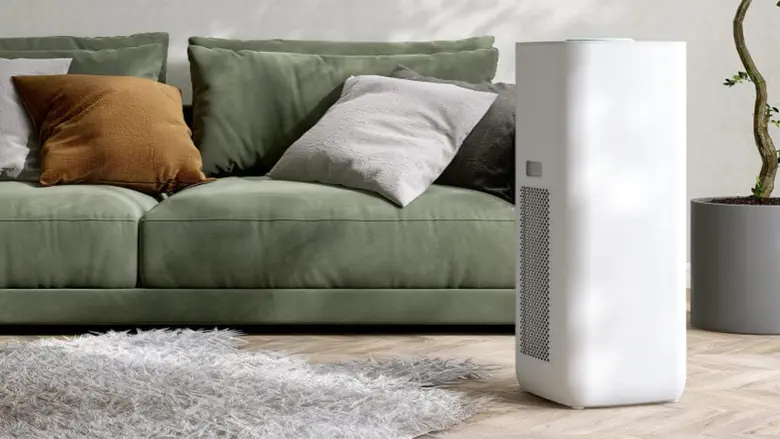
Most of us spend the larger part of the day indoors, in the living room, the bedroom, the office or a waiting room. That is why HEPA filtration at home has drawn the attention of medical researchers, and it helps to know what they actually set out to test before you buy anything.
Why indoor air is a research subject at all
The United States Environmental Protection Agency has reported for years that indoor air is often more polluted than the air outside. That sounds odd until you look at what ends up in a closed room.
Cooking and cleaning products add to it. So does dust that settles into carpets and mattresses, pollen that drifts in through an open window, and emissions from screens and electronic equipment. The outdoor air that enters the building brings its own load on top of that.
In a room with no real ventilation, all of it stays put. People notice it as heaviness or a stale smell, and researchers started asking whether a filter running in the home makes a difference.
The studies that brought HEPA purifiers into homes
Several research groups have tested HEPA purifiers in the places where people live. Tiltan, the official Austin Air importer in Israel since 1994, keeps a list of these papers. The titles include:
- Johns Hopkins University, indoor air quality for pregnant women
- Cincinnati Children’s Hospital
- Lanphear CAPS 2011
- Johns Hopkins, second hand smoke, 2018
- Johns Hopkins NO2 study
- Johns Hopkins COPD, 2021
Look at who is on that list: pregnant women, children, people living with COPD, and households exposed to second hand smoke or nitrogen dioxide. The researchers picked groups for whom indoor air matters a great deal, and looked at what changes when a HEPA air purifier runs where those people spend their days.
What the research can and cannot tell you
Every study is tied to its setting. It looked at one group, one kind of pollution and one kind of device. Reading about one of these papers and then buying the cheapest appliance with “HEPA” printed on the box is a big jump.
Plenty of electrical appliances are sold in Israel under the name air purifier, and the gap between them is much wider than the price tags suggest. The device a study tested and the one sitting on a store shelf may have little in common.
Reading a spec sheet with the research in mind
Start with the filter grade. A true medical grade HEPA filter, grade 13, is required to capture 99.97% of particles at 0.3 micron. Filters made from glass fibre are generally preferred over paper.
HEPA handles particles. Gases and odours from paint, adhesives, cleaning products and smoke need something else, usually activated carbon, sometimes blended with a mineral called zeolite. The CADR figure in many product listings measures particle clearance only. It does not account for the carbon stage or the grade of the HEPA filter, so it says little about how a unit deals with gases.
When comparing air purifiers on the local market, also check whether the unit produces ozone. The California Air Resources Board, the ARB, certifies models that emit none.
Questions to ask before leaning on a study
Who was studied, and does that group look like your household? Was the focus on particles, smoke or a gas like nitrogen dioxide? Did the device use a true HEPA filter, and did it also treat gases?
Then there is room size. Airflow is measured in air changes per hour, and the need depends on the problem: at least three for allergy relief, at least five for respiratory conditions such as COPD, and at least nine for cigarette smoke.
The short version
Indoor air at home has been taken seriously enough to study with pregnant women, children and patients. That research does not cover every appliance on the market, though. Read the study titles, then read the spec sheet with the same care.